

 Русский
  Español
  Deutsch
  Indonesian
  Português
  Français
  Nederlands
  Italiano
  中文
中文  عربي
عربي  Türkçe
 Navigating the Global Market
Navigating the Global Market: Your Guide to Trading Instruments and Server Time
Precision is one of the most important skills a trader can develop. Strategies matter, but timing is what determines whether those strategies work in real market conditions. When trading global markets, you must understand when each instrument is available and how your trading platform uses server time to calculate essential metrics such as the Max Daily Drawdown.
This article explains how server time works, why it matters for risk management, when your trading instruments are open, and why swap charging time is important.
Understanding Server Time and the Daily Reset
Most professional trading environments synchronize their internal clock to New York Time (UTC-5). This keeps all traders aligned with the timing of the world's most active financial center.
The Most Important Moment of the Trading Day: Midnight NY Time
Every trading day ends at 00:00 NY Time. At this exact moment:
Your Max Daily Drawdown resets for the new trading day.
This rule is fundamental to challenge and funded account evaluations.
To understand these rules in-depth, you can explore:
• Max Drawdown vs Max Daily Drawdown
Why Time Zone Conversion Cannot Be Ignored
Although the server clock runs on NY Time, you operate in your own local time. This means:
• Midnight in New York does not equal midnight where you live
• You must convert 00:00 NY Time into your personal time zone
• The correct conversion is necessary to avoid accidental violations of the daily drawdown limit
To make things easier, the platform automatically displays:
• Your local time zone
• Chart timestamps adjusted to your region
• Instrument trading hours based on your location
Even though the server operates on NY Time, you always see information in your own time zone for clarity and accuracy.
Recommendation
Want Everything in New York Time (UTC-5) Instead?
If you prefer to trade with all timestamps, charts, and trades shown in New York Time (UTC-5), you can switch your account to New York Time (UTC-5) Time. Some traders find this easier because it keeps everything aligned with the server’s daily reset.
How to Change Your Time Zone
Changing your time zone is simple:
• On the desktop platform, click the clock icon at the top right.
• Select any time zone you want, including the server time zone - New York Time (UTC-5).
• Once you change it on the desktop, the update applies to all platforms automatically.
A Critical Daily Event: Swaps Are Charged at 17:00 NY Time
In addition to the daily drawdown reset, one more time matters for traders who hold positions overnight:
Swaps are charged at exactly 17:00 NY Time.
This is the industry standard used by most online brokers. When the clock hits 17:00 NY Time, any open position eligible for rollover financing will be charged or credited a swap rate.
Why this matters:
• If you hold positions past 17:00 NY Time, you will incur swap costs
• Wednesday typically carries triple swaps for FX pairs because it accounts for weekend settlement
• Knowing swap timing can influence your risk, especially during challenges where every dollar of equity affects your drawdown metrics
• Each symbol has its own swap rate. You can see it under “Symbol Info” in the platform.
To learn more about the instruments where swaps apply, you can visit:
https://tefs.com/blog/249-explore-the-financial-instruments-offered-by-tefs/
Availability of Key Trading Instruments
Global markets follow the schedule of the financial exchanges they originate from. Understanding these hours helps you plan trades effectively and avoid unnecessary frustration.
1. U.S. Stocks
U.S. equities have a fixed and predictable schedule.
Trading Hours
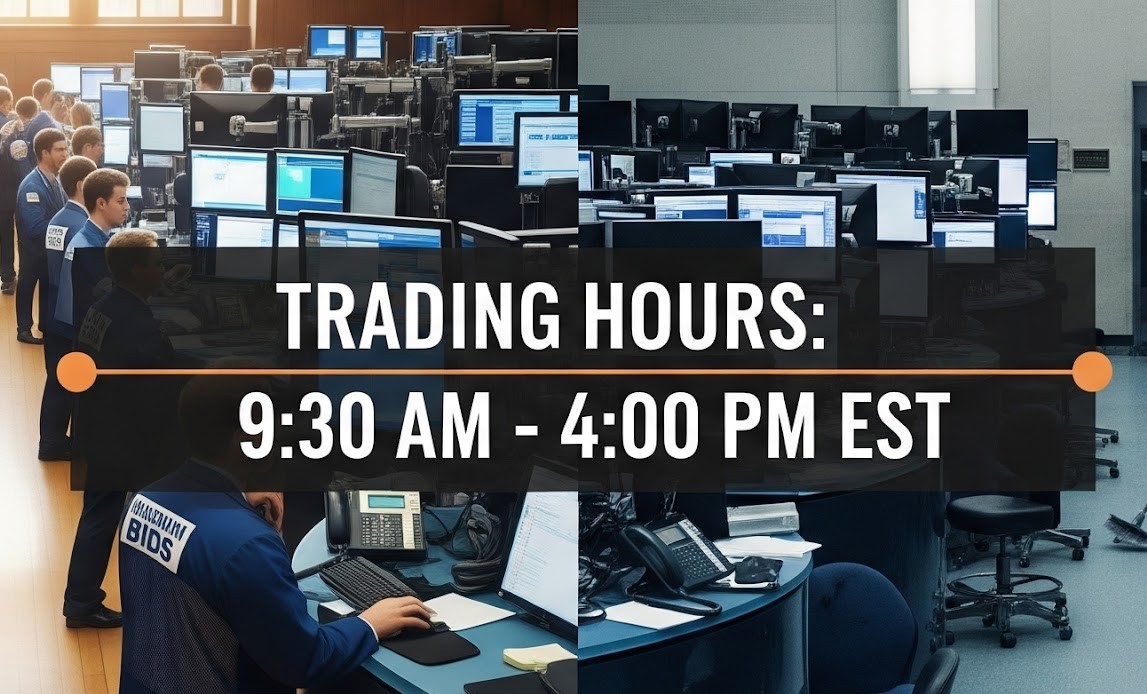
09:30 NewYork Time to 16:00 NewYork Time
Available Instruments
You can trade more than 2,500 active and liquid U.S. stocks.
2. Cryptocurrencies
Crypto markets operate independently of traditional exchanges.
Trading Hours
24 hours a day, 7 days a week
There are no holidays or closures. Trading never stops.
Available Instruments
Bitcoin, Ethereum, Litecoin, and many other major digital assets.
3. Forex, Indices, and Commodities
These markets follow the global business week.
Trading Hours
Nearly 24 hours a day, 5 days a week
Small breaks occur depending on the specific instrument.
Where To Check Exact Times
To see detailed sessions and minor breaks, open the symbol info section inside the platform.
A Simple Analogy for Time Zone Awareness
Imagine a central train station that operates on a single Master Clock. Your personal watch may show a different time, but the last train always leaves according to the Master Clock. Trading works the same way.
• Midnight New York Time (UTC-5) is the Master Clock for the daily drawdown reset
• 17:00 NY Time is the Master Clock for swap charges
You must adjust your own local time to these critical events so you never miss the reset and never get surprised by a swap charge.
Final Thoughts
Success in trading requires a balance of timing, awareness, and strategic execution. By understanding:
• When your daily risk limits reset
• When swaps are charged
• When each major asset class is available
• How the platform aligns server time with your local time
You gain a powerful advantage and reduce the risk of unnecessary errors. Traders who master timing often outperform traders who only focus on signals or setups.